Voluntary Society - Unknown

Not sure which you are? This may help.
Collectivist Individualist
If you believe that individuals should serve, sacrifice for or be subservient to groups, governments or religions in the name of altruism, nation or god, that people should be forced to pay when they are insufficiently charitable, that people are entitled to housing, medical care, retirement, a job, a fair wage, equal wage or minimum wage, then you are a Collectivist. If you believe that you should not initiate force or engage in fraud, that anything voluntary is OK, that you have the individual right to self-ownership, property and the freedom the use it as you please, that you are responsible for your property and its defense, and that property damage must be compensated, then you are an Individualist.

Unlike some libertarians who will tolerate a little slavery in order to sustain minimum government, Individualists tolerate no slavery, and hence seek no government. Individualists will voluntary sacrifice for a mate, progeny and others out of self-interest, but not for any external interest. Individualism is the natural order.

Mercantilism - A Love Story

Socialists and other collectivists would often be in agreement with libertarians and other individualists and many independents were it not for the sloppy use of terms.

Michael Moore and Dylan Ratigan must get their terminology straight if they are to influence a broader audience.  What Moore calls "Capitalism," what Ratigan calls "Corporate communism" and what others call "corporate welfare," "corporatism" or "corporate collectivism" is "mercantilism":  favored businesses get subsidies, market monopolies, military support and protective tariffs, quotas, taxes and regulations in exchange for "donations" to politicians and pay-off jobs for bureaucrats.  Mercantilism was the basis of the British Empire as exemplified by the East India Trading Company.

Mercantilism along with a strong central government, a central bank, massive construction projects and imperialism were advocated by Alexander Hamiltion and other "Hamiltonians," who were frustrated by the limited government, free trade "Jeffersonians" throughout the first 77 years of the USA.  This centralization of power came to be known as the "American System," which was forcibly imposed on the USA by President Lincoln after two decades of being frustrated by southern Democrats while a Senator.

The American System is the legacy of the Republican Party.  It is similar to a form of collectivism called "fascism."  The American System was advanced by the Federal Reserve Act, Revenue Act (income tax), 16th Amendment and 17th Amendment, which were enacted under dubious circumstances in 1913.  Hoover, FDR and most subsequent presidents expanded the American System under which we suffer today as exemplified by the inappropriately titled "Capitalism - A Love Story."

By definition, "capitalism" functions in a market entirely without government perversions.  It is based on "individualism."  It is an ideal that has yet to be achieved.


Moore admits that we do not live in a capitalist society

GWU senior and Liberty Society member Chad Swarthout:
"I appreciate what you said a little bit earlier about how you are concerned really with this corporate welfare system.  Why it is you call your film "Capitalism - A Love Story?" and that you are not actually attacking corportisim, which in my opinion is really what the problem is.  It's that really wealthy individuals, big businesses have such a heavy hand in government.  We have government officials appointed who were working for Goldman Sachs.  I'm not even going to say it, but it's probably not outside of conspiracy.  Realistically is a system of private property and a free market, which is capitalism really a problem, or is it really the fact that we are giving too much power to government and too much power to those working within government who have a heavy hand within, you know back and forth."

Michael Moore:
"We don't really have a free market.  We don't have free enterprise in this country.  As much as they say that we do.  These people, these wealthy, these corporations, they don't really like competition.  They don't like us having a choice.  They like monopolies.  Their nirvana is that they were the only car company, or the only airline.  It's odd isn't it that these people who say they believe so much in our way of life actually believe in a system where they really don't want us to have a choice.  They admire the old Soviet way.  'You only need one car company.'  'You only need one newspaper.'  That is how they think.  I don't want to get hung up in lables.  You're right.  You're absolutely right about the corporatism."

Do listen to the rest of the exchange in which Moore expresses his exasperation with government and voting:  http://www.yaliberty.org/posts/michael-moore-knows-what-capitalism-is-after-all.

P.S.S.

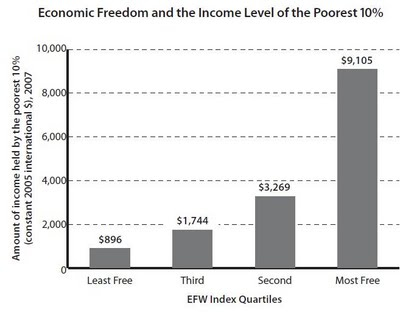
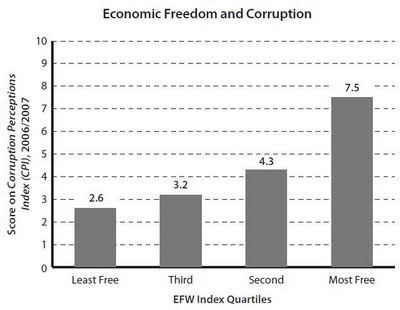
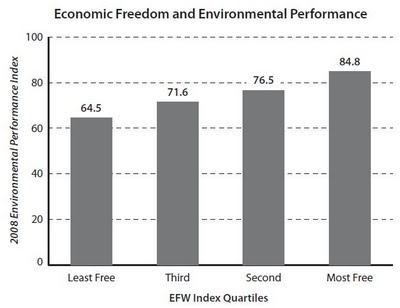
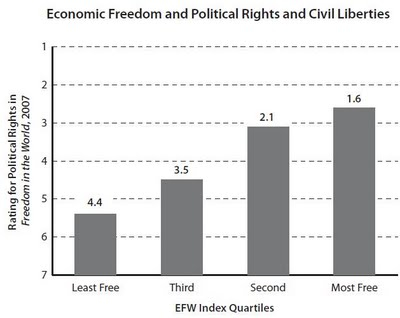
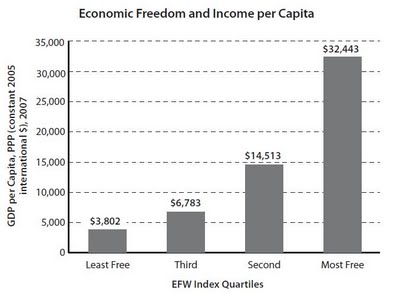
The benefits of relative amounts capitalism/individualism are demonstrated in the following graphs:
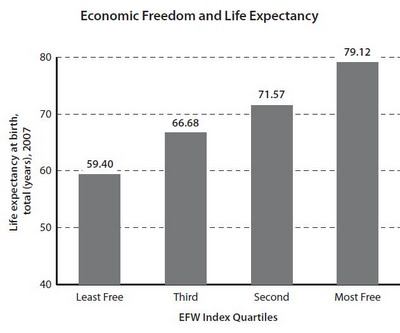
Economic freedom and life expectancy

Economic freedom and income per capita


Economic freedom and income of poorest 10%


Economic freedom and corruption


Economic feedom and environmental performance


Economic freedom and political rights and civil liberties

Source: The Cato Institute's "Economic Freedom of the World: 2009 Annual Report."

| Home |